Doja Cat Tattoos
Doja Cat Tattoos and the Story They Tell
Doja Cat tattoos have become one of the most fascinating aspects of her evolving identity, drawing enormous public interest because they reveal layers of meaning, transformation, and artistic independence. As an artist who constantly reinvents herself, Doja Cat expresses her creativity not only through her music but also through her physical appearance, her visual branding, and the bold imagery she selects for her body art. Her tattoos reflect the same disruptive energy she brings to her performances, her public persona, and her often-chaotic but authentic presence on platforms like Doja Cat Twitter. Because her artistry is rooted in unpredictability and reinvention, every new tattoo becomes part of a broader narrative about who she is and who she refuses to be.
Who is Doja Cat?
Doja Cat, whose real name is Amala Ratna Zandile Dlamini, has a background rich in cultural influences that show up in her sound, style, and visuals. Despite her relatively young age—something that often shocks people researching Doja Cat age—her career already spans viral comedy tracks, Grammy-winning hits, experimental albums, and unforgettable red-carpet appearances such as her dramatic Doja Cat Met Gala look. Understanding her tattoos requires understanding her relationship with transformation. Whether she is performing in a striking Doja Cat red outfit, releasing introspective tracks like those referenced in the Doja Cat Agora Hills lyrics, or navigating the invasive curiosity surrounding terms like Doja Cat naked, Doja Cat boyfriend, or even the spread of Doja Cat leaked rumors, she has chosen body art as a way to reclaim control of her image. Her tattoos are not reactions; they are declarations.
The Evolution of Doja Cat’s Tattoo Aesthetic
As her career progressed, Doja Cat began shifting from soft, playful imagery to darker, more conceptual artwork. This parallels her transition from earlier eras like Hot Pink and Planet Her into the raw, confrontational style of Scarlet. Her tattoos grew larger, bolder, and far more symbolic. Fans began dissecting every piece on social media, interpreting each new design as a clue to her emotional or creative state. Though her online interactions—especially her bluntness and occasional hostility on Doja Cat Twitter—have caused friction within her fanbase, her tattoos often serve as a bridge between her inner world and the audience trying to understand her.
Her early tattoos were small and exploratory—fine-line designs and minimalist illustrations typical of artists experimenting with body art for the first time. Over time, however, she embraced more ambitious pieces that cover significant parts of her back, arms, and torso. She is not interested in cute, easily digestible designs. Instead, she gravitates toward imagery that challenges assumptions and provokes conversation. This mirrors the themes in many Doja Cat songs, where humor and shock value mix with introspection and emotional nuance.
The Meaning Behind Doja Cat’s Most Iconic Tattoos
The Medieval-Inspired Back Tattoo
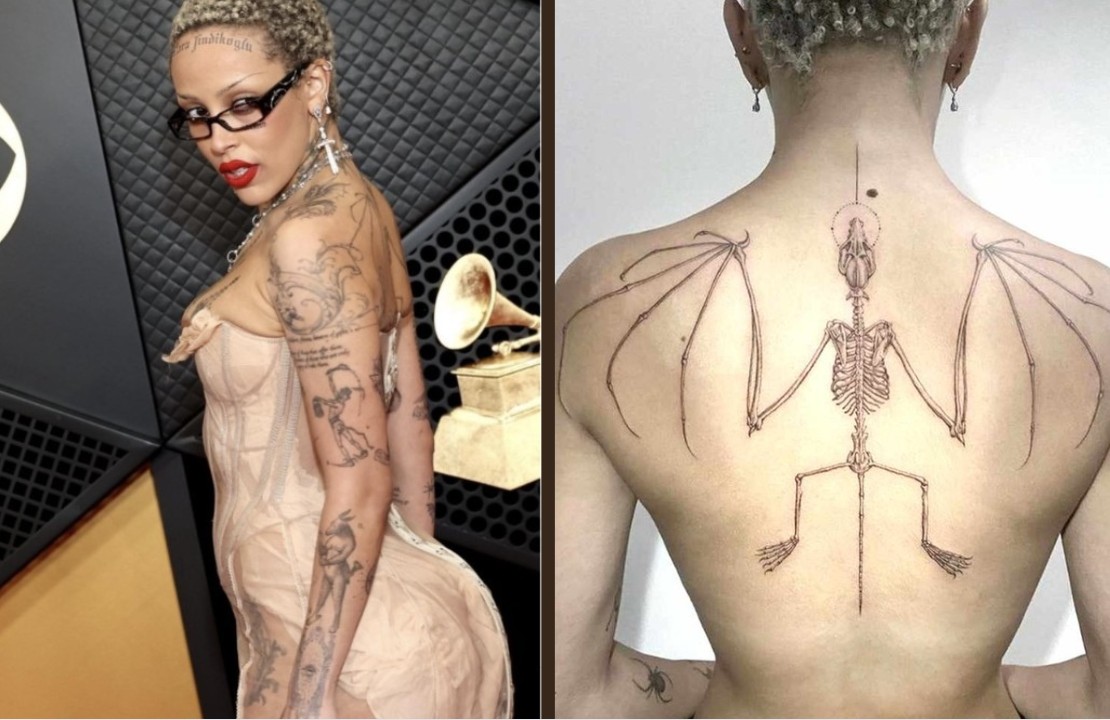
The tattoo that arguably changed the public’s perception of Doja Cat’s artistic direction is her massive back piece, inspired by anatomical drawings from medieval and early Renaissance art. The design is intentionally unsettling, depicting a creature that blurs the line between human, animal, and symbolic representation. Rather than selecting a conventional symbol or a widely recognized figure, Doja Cat chose art that conveys metamorphosis, mortality, and spiritual ambiguity. It reflects a fascination with ancient imagery and ties into the darker atmosphere of the Scarlet era.
The choice is significant because medieval art often deals with themes of transformation and the fragility of the human body. Doja Cat has never shied away from confronting the public’s obsession with her physical appearance. Searches like Doja Cat naked or gossip about Doja Cat leaked images highlight the conflict between her autonomy and the public’s entitlement. Her anatomical back tattoo flips the narrative. It removes the sexualized lens through which people often view her and replaces it with something intellectual, mysterious, and uncomfortably honest.
The “Sinner” Chest Tattoo and Its Symbolism
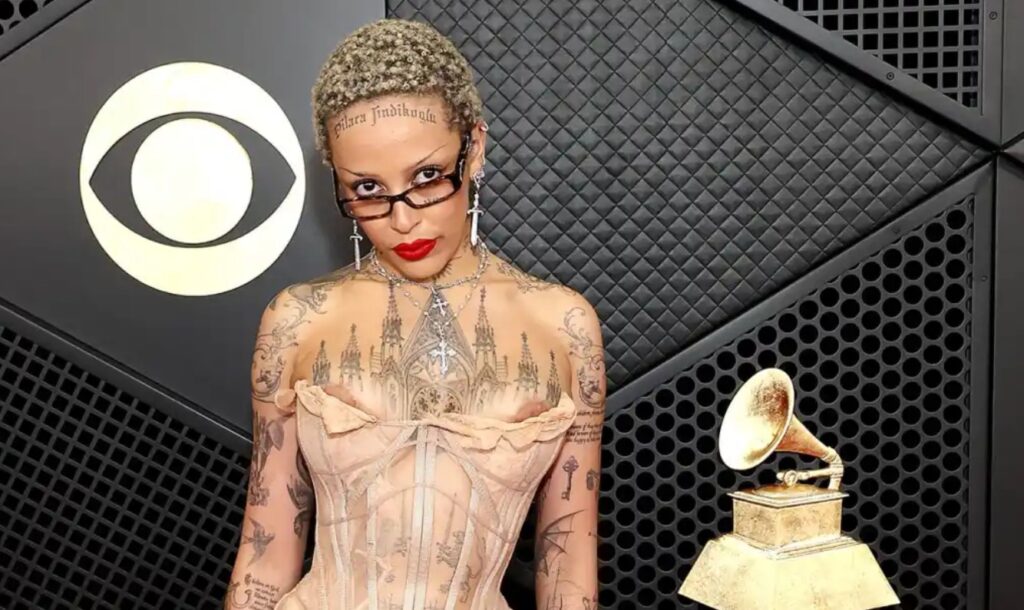
A smaller but equally powerful tattoo is the word “Sinner,” inked across her upper chest. While simple in design, its meaning is far from shallow. This tattoo touches on the recurring theme of moral judgment that has surrounded Doja Cat since becoming famous. Critics have labeled her everything from chaotic to controversial, while fans often project unrealistic expectations of purity onto her. The “Sinner” tattoo acknowledges that conflict while rejecting the idea that she must fit into a pre-defined moral box.
The tattoo aligns with the persona she cultivated during performances that emphasize defiance, rawness, and rebellion. It also resonates with song lyrics that explore duality, self-awareness, and internal struggle. Like her medieval back tattoo, the word challenges viewers to see her beyond the simplified identities used to categorize celebrities.
The Bat Skeleton and Other Gothic Designs
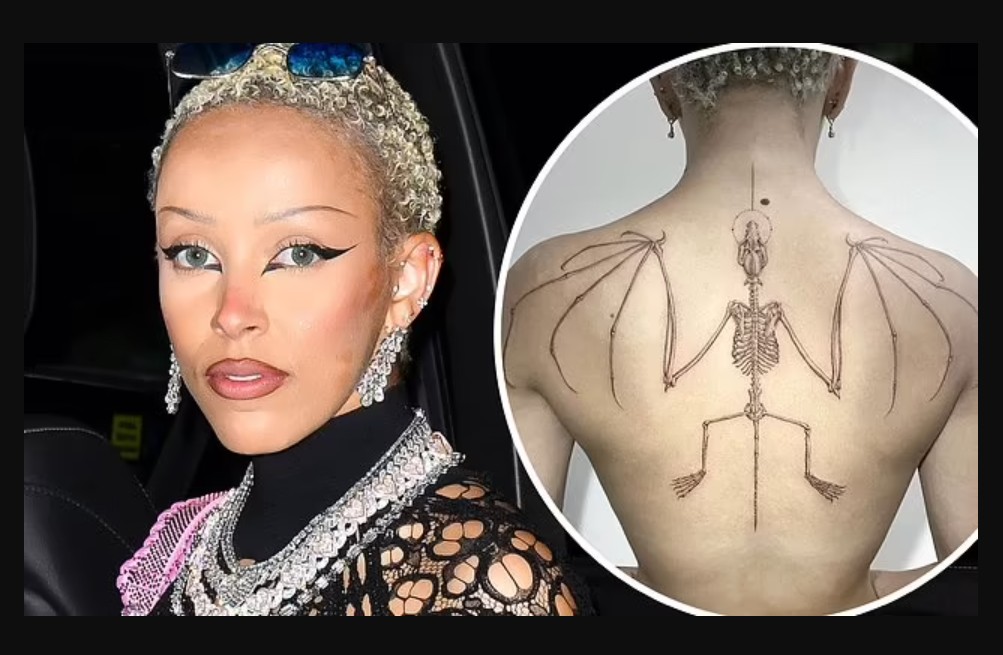
Another striking tattoo is the bat skeleton on her arm. Bats have long symbolized intuition, nocturnal creativity, and transformation. A skeleton adds an additional layer of starkness, suggesting themes of rebirth, decay, and the inner structures we hide from the world. In the context of Doja Cat’s artistic journey, this tattoo symbolizes shedding old versions of herself and emerging with a more honest, unfiltered identity.
The connection between the bat imagery and the emotional tone of Doja Cat Agora Hills lyrics isn’t accidental. That song deals with vulnerability, desire, insecurity, and self-awareness. The bat, as a symbol, represents navigating through emotional darkness with heightened sensitivity. As with many of her tattoos, the design is intimate but confrontational.
She has several other smaller tattoos scattered across her body, each reflecting her interest in surrealism, mythology, and the interplay between beauty and discomfort. None of these tattoos feel like accessories. They feel like statements.
How Doja Cat Tattoos Relate to Her Music and Public Persona
Doja Cat’s body art is deeply connected to her creative evolution. Earlier in her career, her image was playful, colorful, and mischievous, matching the tone of songs like “Juicy” or “Say So.” The public often associated her with humor, sexuality, and internet culture. However, as she matured artistically, her focus shifted toward expressing emotional tension, inner conflict, and darker themes. This shift can be seen clearly when comparing songs from different eras, especially the contrast between her earlier hits and her introspective work in more recent albums.
The imagery in her tattoos mirrors this tonal shift. Her medieval back tattoo embodies a raw, confrontational energy that aligns with songs exploring identity crises, emotional distance, and self-redefinition. The “Sinner” tattoo corresponds to her public rejection of idolization, a stance she often expresses through blunt comments on Doja Cat Twitter. The bat skeleton reflects her willingness to embrace the shadows of her persona rather than hide behind glamour.
Even her romantic life and public speculation surrounding Doja Cat boyfriend rumors contribute indirectly to the interpretation of her tattoos. The media constantly attempts to project narratives onto her relationships, her appearance, and her sexuality. Tattoos function as a form of resistance—an assertion that her story will be written on her own terms.
Also Read: TheLifestyleEdge com Your Go-To Hub for Modern
Why Do Doja Cat Tattoos Generate So Much Controversy?
The controversy surrounding Doja Cat’s tattoos has little to do with the tattoos themselves and more to do with the public’s discomfort with seeing a mainstream pop star embrace imagery that breaks expectations. Society frequently demands consistency and predictability from women in pop culture, rewarding those who fit into digestible categories. Doja Cat refuses that structure. Her tattoos often include dark, gothic, or unsettling motifs, challenging the stereotypical “feminine” aesthetic that many expect from celebrities.
Her back tattoo in particular triggered debates about demonic symbolism, occult themes, and her overall mental state. These reactions highlight how resistant some audiences are to unconventional art. Yet Doja Cat has repeatedly emphasized that her body art is about creative exploration rather than spiritual alignment with any dark ideology. The controversy reveals more about societal biases than it does about her intentions.
Her online persona intensifies the reactions. When she argues with fans or posts provocative statements on platforms like Doja Cat Twitter, critics claim her tattoos reflect rebellion or instability. In reality, they reflect independence. The tattoos are expressions of control over her self-image in a world that constantly attempts to control it for her.
Comparisons With Tattoo Trends Among Other Celebrities
While many celebrities opt for minimalist, delicate tattoos designed to maintain broad appeal, Doja Cat takes a drastically different approach. Her choices draw from medieval art, surrealism, gothic culture, and anatomical illustration. Rather than appealing to mainstream trends, she aligns herself with high-concept art. This puts her more in line with avant-garde performers than traditional pop stars.
Her tattoos are not sentimental tributes or symbolic placeholders. They are immersive visual pieces that reflect a thoughtful and sometimes provocative philosophy. This distinguishes her within celebrity culture and contributes to her reputation as an unpredictable and intellectually complex artist.
The Future of Doja Cat Tattoo Journey
Given her pattern of continuous reinvention, it is almost certain that Doja Cat will acquire more tattoos in the coming years. Her artistic evolution suggests future designs may delve even deeper into surrealism, mythology, medieval symbolism, or introspective emotional themes. The scale of her tattoos has grown significantly, and fans expect her to continue choosing large, meaningful pieces rather than small decorative ones.
As she experiments with new musical eras, fashion identities, and stylistic risks, her tattoos will likely evolve as a visual record of her personal and creative transformation. Each new era of her career brings fresh perspectives, and her body art functions as a living archive of her journey.
Conclusion: What Do Doja Cat Tattoos Reveal About Her?
Doja Cat tattoos form an essential part of her creative identity. They symbolize evolution, rebellion, introspection, and a dedication to artistic authenticity. Whether she is confronting public scrutiny, exploring emotional complexity in her music, or redefining her aesthetic through bold fashion choices such as the iconic Doja Cat red outfit, her tattoos serve as a mirror to her inner world. They challenge conventional beauty standards, provoke cultural dialogue, and reveal a depth that many listeners overlook when they focus solely on her viral moments or public controversies.
Her tattoos tell a story of self-ownership. They are raw, disruptive, and uncompromising—qualities that define her entire career. As Doja Cat continues to push boundaries, her body art will remain an evolving canvas through which her audience can glimpse the emotional and philosophical layers behind the music.
Frequently Asked Questions About Doja Cat Tattoos
Does Doja Cat have a lot of tattoos?
Doja Cat has accumulated several tattoos over the years, ranging from small fine-line pieces to large, highly detailed artwork. Her growing collection reflects a shift toward darker, more conceptual imagery, especially as her music and public persona have evolved.
What is Doja Cat’s most famous tattoo?
Her most widely discussed tattoo is the massive medieval-inspired anatomical design covering her back. It became a major talking point because of its size, symbolic depth, and the way it signaled a new artistic era for her.
Do Doja Cat’s tattoos have specific meanings?
Many of her tattoos contain layered symbolism tied to themes of transformation, mortality, rebellion, and identity. Others are inspired by visual art, mythology, or her interest in gothic aesthetics. While some people try to assign fixed interpretations, Doja Cat often leaves room for personal and artistic ambiguity.
Why do Doja Cat’s tattoos cause controversy?
Her tattoos challenge the public’s expectations for female pop stars, especially when the imagery leans into gothic, unsettling, or medieval symbolism. Critics sometimes misinterpret her art as occult or intentionally shocking, but the controversy usually reflects societal discomfort with unconventional female expression rather than her actual intentions.
How do Doja Cat’s tattoos connect to her music?
Her tattoos often mirror the themes present in her albums and lyrics. For example, the emotional complexity in the Doja Cat Agora Hills lyrics aligns with the introspective and symbolic imagery she chooses for her body art. As her sound shifts, her tattoos tend to evolve alongside it, reinforcing her aesthetic direction.
Has Doja Cat spoken about getting more tattoos?
While she has not outlined a definitive plan, her artistic trajectory suggests she will continue to expand her tattoo collection. Her recent pieces demonstrate a growing interest in large, meaningful designs, indicating that future tattoos are likely to follow this expressive and conceptual path.
How do fans generally react to her tattoos?
Fan reactions vary widely. Many admire her boldness, creativity, and willingness to experiment. Others feel shocked or confused by the darker imagery. Regardless of the reaction, her tattoos consistently spark discussion and deepen interest in her broader artistic identity.
Do her tattoos affect her public image?
Yes. Her tattoos reinforce her reputation as a boundary-breaking artist who refuses to conform to traditional pop-star expectations. They serve as visual declarations of independence and help shape how the public interprets her music, performance style, and persona.
Also Read: Zvodeps The New Age Framework of Integration, Creativity, and Efficiency
About the Author